Rich foolishness

 A sermon for harvest 2024 based on Luke 12:16-21

“The land of a rich man produced abundantly. And he thought to himself, ‘What should I do, for I have no place to store my crops?’ Then he said, ‘I will do this: I will pull down my barns and build larger ones, and there I will store all my grain and my goods. And I will say to my soul, Soul, you have ample goods laid up for many years; relax, eat, drink, be merry.’ But God said to him, ‘You fool! This very night your life is being demanded of you. And the things you have prepared, whose will they be?’ So it is with those who store up treasures for themselves but are not rich toward God.”

The gospels are written in unbelievably condensed language. This morning’s reading, the Parable of the Rich Fool is told in 125 words. I would guess that if any of us were asked to retell the story as concisely as possible we would use many more.

It is impossible to believe that this is how Jesus actually spoke in public. People who make a considerable effort to hear a public speaker don’t typically want a sequence of super-condensed sound bites. They want to be captivated, inspired and entertained by something more substantial. The gospel writers have captured the essence of the parables as concisely as possible, but if we want to relive the experience of Jesus’ preaching and teaching we have to imagine the bits that the gospel writers leave out.

We also need to remember that the people that Jesus was talking to two thousand years ago when he first told the story lived very different lives to those we live today. They would have recognised things in the stories he was telling that we risk missing. Most of Jesus’ teaching was in Galilee, a largely rural province with poor links to Jerusalem the more cosmopolitan city in the south. The country was poor with many people with little education and dependent on subsistence farming or fishing. They would have recognised and related to quite different things in the stories to those we recognise and relate to today.

The story, for example, is that of a rich man. In our world we tend to idolise the rich. We often assume that with their wealth comes knowledge and wisdom. We might assume that a rich man will be the hero of a story. Poor people, particularly tenant farmers, will often have a different perspective. Throughout history the rich, or at least those who have not inherited their wealth, have often accumulated their wealth through exploitation of the poor. Think of how many of the super-successful businesses of today award great salaries and bonuses to their owners and top-level management but refuse to pay their front-line staff any more than the minimum wage. In unregulated subsistence economies like that of first century Galilee the poor people listening to Jesus would almost certainly have responded to the introduction of the character as a “rich man” with suspicion and contempt. It’s not beyond imagination that they might have responded with pantomime boos and jeers.

There has been a good harvest, presumably because of factors entirely beyond the control of the rich man – rain at the right time to germinate the seeds and sun at the right time to ripen the grain. The crowd would know that a good harvest was a gift from God and had little to do with the merits of the landowner. They would also know that the man had had little involvement in gathering the harvest other than to order his stewards to recruit casual labour from the gig economy at rock bottom wages. The crowd might even understand that the man only owned the land because he had inherited it form his father, and he from his father before that, right back to the time when some ancestral warlord had stolen the land from those who had originally inhabited it.  Despite all this the man has no reservation in asking, “What should I do to for I have no place to store my crops?” with a very clear emphasis on “my”. More boos and jeers from the crowd?

And what of his decision to build bigger barns? Why not just sell the excess grain. The audience knew the answer, there’s a business opportunity isn’t there. If the man has experienced a bumper harvest, then the chances are that other landowners have as well. Grain will be plentiful, and the price will have dropped. Building bigger barns is a mechanism for hoarding the harvest until a future time when grain becomes scarce and the price rises accordingly. The crowd listening know that the building of bigger barns is a mechanism for extorting higher prices for grain from them sometime in the future. They see investment of current wealth as a mechanism for exploiting them to generate yet more wealth in the future. Even more boos and jeers.

The rich man is satisfied and looks forward to the security of consolidated wealth. Imagine what that feels like to subsistence farmers and hired labourers who never know where their next mouthful of food is coming from. There can have been little sympathy for the wealthy man. It there were any wealthy people in the crowd you can imagine them getting a little nervous and sweaty as Jesus progresses with the story. You can imagine why, ultimately and corporately, they decided that Jesus was a dangerous influence who needed to be done away with.

But for the moment Jesus is speaking the language of the crowd and has got them in the palm of his hand. Then the punchline. God takes the life of the rich man. All that wealth squirrelled away, all that prospect of future comfort, all have come to nothing. Did the boos and jeers of the crowd turn to cheers and laughter. Yes, the rich man has got his just desserts.

One problem with this parable is that it is almost entirely negative – it is clearly very critical of how the man did behave but tells us very little about how he should have behaved.  At the heart of the story is the question that the rich man asks himself, “What should I do for I have no place to store my crops”, what should he have done?

This is an example of Jesus genius in responding to a question by telling a story which makes the answer obvious to the audience without needing to give it. He did it with the Parable of the Good Samaritan and his response to the woman caught in adultery. Here he tells a story which makes clear the Christian response to wealth generation without having to state it explicitly. The Christian response to wealth generation is to give thanks for good fortune and to seek to share that good fortune with others.

One thing that puzzles me about the modern church is why we are not more critical of hoarded wealth, why we don’t tell equivalent stories. You can imagine the trouble that the we would get into if it started filling out this story in the way that I’ve imagined Jesus filling it out. We’d be told to keep our thoughts away from politics and to get back to praying silently on our knees where we belong. Perhaps one issue is that, in a complex world, the injustices of how society is structured are much more difficult to discern than in the earlier, simpler world in which Jesus taught. Or maybe it is because those with wealth are controlling how we perceive the world.

We are currently fed a story that our economy is failing, that as a nation we have no money to spare and that we need to cut back on provision of services to the disadvantaged and vulnerable because we have no way of funding them. We are taught that the only way that we can find such resources is by growing the economy. This is simply not true. We are the sixth wealthiest nation in the world in terms of our gross domestic product. According to the Organisation for Economic Cooperation and Development GDP is “the standard measure of the value added created through the production of goods and services in a country”. Accountants and economists might argue about the details, but you can think of this of the money that we earn as a country each year. If you divide this by the number of people in the country you obtain an estimate of how much income every person would receive if that money was shared equally among the population. According to the International Monetary Fund this is projected to be just under £40,000 per person (US$51,000) for 2024. This is the whole population, so every family of two adults and two children could receive £160,000 each year. The key issue here is that this would be the case if the country’s annual income were shared equally among the population – it isn’t.

How would the national dialogue on how we manage the country’s resources and share its wealth be different if we told the truth with the same clarity that Jesus told the truth? How would it change, if gloomy predictions of how slowly the economy is growing where replaced with celebratory statements of how much wealth we already generate. Harvest is a time to give thanks for what we have received and to then think about how we share it. This harvest, let all Christians in the UK strip away the gloom of how slowly the nation’s income is growing and give thanks for the abundant wealth which we already receive. But let’s go further than giving thanks, let’s take the next step and ask how that wealth should be shared.

What can we learn from the book of Revelation about our world today.

This month is Bible Month which is looking at the book of Revelation and this week the material suggests we look as chapters 10-13 with the heading “Witness, worship and waiting”. This seems a little odd as the traditional chapter divisions don’t marry up with the different sections in the book. Chapter 10 picks up in the middle of one section and Chapter 13 leaves off in the middle of another. I’ve thus chosen to concentrate on Revelation 12:1-15:4. This is a more sensible unit which, in my Bible commentary is given the title “The story of God’s people in conflict with evil“. The passage is not easy to understand so I’ve prepared a summary that you can read at this link.

I preached this sermonoon 18/06/2023 after the reading of Revelation 12:1-17.

So how are we supposed to make sense of this sort of reading in the modern world?

First, I think we need to acknowledge that this is a vision, or a dream. John, the author, makes this clear in the very first verses of the book. The language is poetic and metaphorical and should not be taken literally. Second, it contrasts the contemporary world of the author, and the power structures within it, to the world intended by God and revealed in the scripture. It is not a vision of the future and there is no value in trying to go through the book and work out how it predicts various events of world history. So if we want to explore its relevance to us today we need to explore which characteristics of the historical world that it portrays are still relevant today.

John uses thinly veiled imagery to comment on the Roman empire (the first beast). He sees this as the agent of the devil. Something opposed to what God wants. One of the key characteristics of the opposition is that it calls people to worship it rather than God. As we know, the Roman Emperor was considered divine and worshipped. At the stage in history that this letter was written, the Romans were extremely tolerant of all sorts of religions, as long as people would worship the Emperor as a god, as well as their own gods.

In the current world we don’t have a single political entity that exerts power in the way that Rome did, but we do have political and economic ideology that is becoming dominant throughout the world. It’s an ideology of materialism and consumerism. At its heart is a worship of money. It started off in Europe and North America and is now spreading out its tentacles to embrace the whole world. It’s like Rome in that it is amazingly tolerant of other world views and religions as long as people acknowledge its power as well. Christians, Jews, Muslims, Hindus, Buddhists, are all welcome to express their faith however they want, as long as it fits in with predominant worldview of a consumer economy.

John’s second beast is subservient to the first beast but no less dangerous. It represents all those people and organisations that collaborated with Rome and were effectively agents of its power. Rome exerted its power by unholy allowances with local rulers. Rulers would pledge allegiance to Rome and pay their taxes promptly. In return Rome would use the threat of its military might to keep that ruler in power. Herod, the Biblical king, was a good example of this.

In the current world we can recognise all sorts of organisations who feel that they need to accept the predominant world view in order to secure their own existence. Many political parties and charities are essentially allowed to operate and survive only if they acknowledge the unquestionable power of the markets. It is fine for charities, for example, to provide food to people who are impoverished by the way our world works, as long as they do not criticise the system that has caused that poverty. We now even have laws in the UK that prevent charities from expressing political viewpoints. We also see this in international relations. A broad summary of how the United Nations and World Bank works is that they will offer financial support to poorer nations, as long as those poorer nations promise to abide by the terms of a globalised consumption based market economy.

John calls this out. It’s not right he says. Rome may be the dominant power, it may be a tolerant power, the lives of the wealthy and powerful may have been made much easier if they collaborated with that dominant power, but it is not what God intended. God did not intend a world in which everyone was subservient to the Roman emperor and enslaved to the economic and political system that he represented. God intended a world in which we would love God, love each other and live our lives in all the fulness that this offers.

I believe the same message is true with the dominant world power today. A consumer based market economy may be the dominant power, it may keep the wealthy and the powerful in control, but it is not what God intended. God did not intend a world in which everyone is desperate for material possessions and tied into a system in which they face destitution if they fail to work for a meagre minimum wage. God intended a world in which we would love God, love each other and live our lives in all the fulness that this offers.

Perhaps most importantly though John’s vision is of conflict. John sees the Roman empire as an evil that has to be resisted and fought against. There is a call to action and opposition. This opposition comes primarily from a Christian community that sees itself as different, that is not subservient to the current world view. The mark of the beast is a mark of collaboration with the dark power, with Rome. It is a mark on the forehead of everyone. Averyone apart from 144,000 sof the people of God. Final victory is portrayed as coming about through a community who mark themselves out as different to the rest. People who are in the world but not of the world in which they found themselves.

I believe this is the calling of the church today. Our calling is to be in the world but not of it, to mark ourselves as opposing the dominant world view and willing to hold fast to God. It is through that faithfulness to God that victory will come.

It’s interesting to me that although my Biblical commentary refers to the 144,000 as the “Army of the Lamb”, there is no mention of an army, or any reference to any armour or weapons or military tactics. It’s interesting how this in itself attests to our subservience to a military-industrial worldview. Even the author of a commentary on the Bible assumes that a large group of people opposing evil is best described as an army.

But the 144,000 are not an army (at least not in this section of Revelation). The 144,000 are a worshipping community. They don’t brandish swords, they sing songs. They don’t attack to kill, vanquish and coerce, they hold up a vision of the world as God intends it. Their victory comes not through military prowess but by worship and witness. Our first priority, in a world that worships mammon, is to continue to worship God. Not a God that conforms to the dominant worldview, but one who has a completely different world view offering good news to the poor, sight to the blind and freedom for the oppressed.

The second priority is to bear witness by living out our lives in the light of that vision of how God intends us to live. We need to be seen to be a community who live differently, we need to tell each other, and the wider community of how our lives have been affected by our experience of God’s love.

The final, and less comforting message, is that we need to do this in expectation of opposition. John was writing after a period of persecution of the early Christian community, particularly of the community that had grown up in Rome. John knew that Christians had died for their faith, and he saw this testimony as one of the most powerful tools that community had to express its difference and opposition to Roman authority and to hold up its vision for a different world. Christians, as people of peace and sacrificial love, could not and should not oppose power with violence. Expression of their identity in the peaceful love of God and as separate to the values of the world was the only power they needed to defeat evil.

If we are to defeat the evil in our contemporary world then we must expect opposition. The evil we confront today is much more subtle and pernicious than the brute force of Rome. We are more likely to confront mockery or even indifference than we are to encounter physical violence, but we still need to resist this and hold true to our faith. We can even question the strength of our faith as a Christian community through the observation that we are not, in most parts of the world, persecuted. Where Christians are persecuted in the world today, it is because they are perceived as a threat to the dominant world view. The fact that we, in the UK, are not persecuted as Christians is largely because we do not pose a threat to anyone. Perhaps we should. Perhaps the lack of persecution of Christians in the UK is a sign that we are not responding to John’s vision of Church that stands apart from the world and proclaims an alternative to it. Perhaps we should be more prepared to take a stand, to proclaim that there is an alternative, and to start to live that alternative out.

So let’s not dismiss this passage as the ranting of a first century madman. Let’s look behind the words and images to the critique that he offers of the world in which he lived. Let’s see in it how little the world has changed and learn lessons from it. Above all let us see ourselves as different to the world in which we live. Let us live our lives out as if we are different. Let us hold to that vision and that lifestyle even when we face opposition. For it is through our worship and our witness that God’s final victory will be won. That all people will eventually come to recognise his face and live lives in all the fulness that that offers.

Blessed are you who are poor?

A sermon preached on Luke’s version of the Beatitudes – Luke 6:20-26.

Luke and Matthew both have accounts of the Beatitudes. They are different. Matthew locates them within an early sermon delivered on a mountain side, Luke also places them in an early sermon but one located on a plane. Matthew has eight, whereas Luke only has four. But then Luke includes four woes that repeat the beatitudes in a negative form. “Happy are you poor”. “How terrible for you who are rich”.

The wording also differs. Luke’s statements are short political statements about life as it was lived at the time. Matthew’s statements are more metaphorical with an essentially spiritual or religious message. Thus, Luke says simply “Happy are you poor” a statement about literal poverty, whereas Matthew says “Happy are you who are spiritually poor”, a statement using poverty as a metaphor for our spiritual health. Luke says “Happy are you who hunger” another literal statement whereas Matthew says “Happy are you who hunger for righteousness”, another metaphor about how we are spiritually.

There has been considerable debate among Christian scholars about how to account for these differences. The overall structure is sufficiently similar to assume that both gospels are referring to the same set of original sayings. Like most preachers Jesus will almost certainly have delivered similar but not identical sermons on different occasions to different people. It might be that Matthew and Luke are referring to different sermons. But then these particularly sayings are formalised almost as poetry. They don’t strike me as casual language that might vary from sermon to sermon, they feel like precisely worded epigrams that Jesus has polished and honed to say exactly what he meant to say. It’s quite possible that Jesus formalised the beatitudes in this way as a teaching tool with the intention that they could be remembered word by word. Here is something that is so important that you must remember it exactly.

The theory that most scholars hold to is that the gospel writers moulded what Jesus said to their own theological perspective. Luke, who probably says more about money and its corrupting power, than any of the other gospel writers, presents the beatitudes as being about actual poverty. Matthew, who is generally much more interested in Jesus as a religious figure, presents the beatitudes as being about spiritual poverty.

So which is correct? What did Jesus actually say? The short answer is we don’t know. Scholars vary in their opinions and, as might be expected those opinions tend to reflect the theology of the scholars. Those who see Jesus as primarily a figure of religious significance, tend to assume that Matthew’s version is the closer to the original. Those who tend to think that Jesus offered a political gospel will tend to prefer Luke’s version.

There are other clues. Generally speaking when similar sayings are found in the gospel, but one is longer than the other scholars tend to assume that it is more likely that an original shorter statement has been added to rather than that words from the longer statement have been deleted. Also in 1945 a “Gospel of Thomas” was discovered in the Egyptian desert and is believed to be a very early collection of the saying of Jesus. It includes another set of beatitudes that are much closer to Luke’s version than Matthew’s. Another argument, that sways me, is that where two such similar statements are found in the gospels, and one seems at odds with how early Christianity was developing at the time that it was written down, then that is most likely to be the true version. It is much more likely that someone would edit material to be in line with later thinking than to contradict it. It seems clear to me that much of the political radicalism that we read in the synoptic gospels was lost as the early Christian movement focussed on Jesus as of primarily religious significance. Luke, as a disciple of Paul, was part of that movement and it seems unlikely to me that he would have edited Jesus’ sayings to make them more political in nature. On balance, I think that Jesus’ original teaching was probably about real poverty and real hunger and real grief.

If we accept this, the first thing we have to ask is, “Does Jesus really think that poor, hungry, weeping people are happier than rich, satisfied, laughing people?” Is he saying that there is something that is inherently good about poverty and hunger? Should we intentionally make ourselves poor and hungry in order to find God? Is poverty the way to godliness?

If we start to think this way, then we have fallen into a trap. When Jesus talks so positively about “the poor”, he is not eulogising their status (he understood the desperation of their poverty all too well to do this), he is celebrating their potential. They are not happy because they are poor, they are happy because they will recognise God’s Kingdom when they see it. They are not happy because they are hungry, they are happy because they will be so appreciative when they are fed. They are not happy because they weep now, they are happy because one day they will laugh.

Another issue is in how we regard “the poor”. When we read this passage as Western Christians in a comfortable church in a reasonably affluent town just south on Manchester, “the poor” is “them”, somebody else, somebody out there. When Jesus was speaking in rural Galilee all those years ago, he was speaking to a crowd who recognised themselves as poor, hungry and weeping. They knew they were subjugated both by local civil and religious authorities and their Roman overlords.  “The poor” is “us”. Jesus is making a statement of solidarity with the people he is speaking to. Jesus is not just saying happy are the poor, he is saying happy are we, we are in this together.

But he is saying more than that he is not just saying “we are in this together”, he is saying “we are in this together and we have wonderful things to share”. When communities share each other’s poverty and hunger and grief they are in a much better position to build a kingdom of love than those who struggle individually to maintain wealth and privilege.

We went out to the cinema for the first time in two years last night. We saw Belfast, Kenneth Branagh’s memoire about his early childhood. We were taken to a terraced street in working class Belfast. This was not a place of abject poverty but it was a place of where people struggled to make ends meet and lived in fear for their lives as the political situation deteriorated. But it was also a place of community. The street itself was full of life with children playing and older people taking their chairs outside to sit and pass the time of day with whoever was passing. Everyone knew everyone else, and they cared for each other and helped each other out. Multigenerational families lived their lives in close proximity. When Kenneth’s father suggests that moving to England would give them an opportunity to progress, his mother questions why anyone would want to progress from the strength of that community that supported each other through hardship. Branagh may be seeing that time and place through the rose-tinted spectacles of his childhood, but he is clearly nostalgic for a society that bound people together in solidarity, a society which he has left and can no longer access.     

Of course if Luke’s four beatitudes are about “us”, then the ensuing woes are about “them”, those who are rich, satisfied and laughing.. Those people back in the city concerned only with creating more wealth. Those people back in the religious buildings trying to persuade themselves that a particular form of worship is the gateway to finding God. Those people who separate themselves off from each other so that they can enjoy their wealth on their own. Those people who are incapable of working to build God’s Kingdom because they have lost sight of who God is and what that Kingdom might look like.

When read in this way this passage cuts through to life in twentieth century Britain doesn’t it. We have a divided society. A society in which more and more of God’s people are struggling to make ends meet – to both eat and heat, but also a society that is driven by the conceits of the wealthy and powerful. An elite that separate themselves off from the majority of the people. An elite that are incapable of working towards the coming of God’s Kingdom because they have lost sight of who God is and what that Kingdom might look like.

The beatitudes offer us a choice. We can align ourselves with the poor, the hungry and those who weep, or we can align ourselves with the rich, the satisfied and those who laugh. But they do more than offer us a choice, they tell us which choice we should make and why.

We should align ourselves with the poor, not because we admire their poverty, but because we know that they will recognise God’s Kingdom when they are encounter it. We should align ourselves with the hungry, not because hunger is good, but because of how we know they will savour food when it is provided. We should align ourselves with those who weep, not because we love tears, but because we long to bring laughter. Let’s take these thoughts into our next hymn “Community of Christ”,

What does John’s account of turning water into wine mean for us today?

A sermon based on the story of the Wedding at Cana (John 2:1-11).

As I was sitting in church last week my eye was caught on one of the slides shown before the service. It was publicising the topic for today’s service: “What does John’s account of turning water into wine mean for us today?” I was intrigued and looked forward to that service. Unfortunately the following morning I had a phone call from Mandy to say that she wasn’t going to be able to take the service and asking if I could stand in for her. I was a little disappointed that I wasn’t going to hear her answer, but decided I’d keep her theme and have a go at answering the question myself.

This quesion relates, of course, to the set lectionary reading for today, the very familiar story of Jesus at a wedding in Cana. The wine runs out at the party and, reluctant but urged on by his mother, Jesus rescues the situation by turning water into wine. It is fundamentally, of course, a miracle story. A miracle story that marked the start of Jesus’ ministry (according to John’s Gospel). The final verse of the reading makes it clear that this is why the author considers it important, “Jesus did this, the first of his signs, in Cana of Galilee, and revealed his glory; and his disciples believed in him.” For almost all of Christian history this is how Christians have found meaning in the story. Jesus performed a miracle and by doing so revealed who he was.

The question Mandy posed though isn’t “What has this story meant for generations of Christians in the past?” It is “What does it mean for us today?” How do we, in the modern world, respond to miracle stories? How do we respond to this story?

We can try and respond scientifically. I’ve managed to find a scientific paper that looks at the physical chemistry behind turning water into wine. The fundamental difference is that wine contains alcohol (let’s assume about 12% of the total 20 gallons). This alcohol could have come through a chemical reaction between water and carbon dioxide in the air in the room. When you do the sums, you find out that this takes energy, which is why it doesn’t happen spontaneously and why you can’t just leave a glass of water out and wait for it turn into Shiraz (or Prosecco depending on your preference). When you calculate how much energy it turns out to be equivalent to boiling a standard kettle about 500 times. Where did all that energy come from?

Alternatively, assuming that the carbon dioxide has come from the air but knowing that it is only present in the atmosphere in very small quantities, you can ask how much air would have been needed? It turns out you’d need all the carbon dioxide from a room about 25 times the size of this church. Where did it come from?

When we mix modern science with ancient miracle stories, we conclude that those stories are even more mind-blowing than our ancestors have ever appreciated. The ancients would certainly have seen this miracle as an amazing feat but one amongst so many other things they didn’t understand about how the world functions. We see it as something that is simply not possible, even non-sensical, given our current understanding of how the physical and chemical worlds behave. Some people will say, “Well of course, this just shows how God is more marvellous, more powerful, more awe-inspiring than previous generations could possibly have imagined”. If you are one of them, then that is fine. Others will want to ask, “Are there other ways of reading this story which might bring out a different meaning?

The story is one about how Jesus fulfils a need. People are at a party, they are having a good time. They’re eating and drinking, they are singing and dancing, they are catching up and sharing news and jokes. They feel good about themselves and the lives they are leading. All the world seems rosy and then … the wine runs out. Let’s put aside Methodist concerns that alcohol shouldn’t be a pre-requisite for having a good time, and accept the host’s concerns that this is a disaster. The bubble risks being burst – the party will be over.

Jesus doesn’t want to act, but he does. He turns the water into wine. Not any old wine, not the wine that had been served earlier in the evening but a wine that the guests recognise as the best wine they have ever drunk, and in huge quantities, (20 gallons is about 120 bottles). The need has not only been fulfilled but it has been fulfilled completely and extravagantly. Later in John’s gospel (John 10:10) Jesus says he has come so that other people may have life, life in all its fulness. In John’s gospel this is the first story of Jesus’ ministry, and it is a story of Jesus bringing life in all its fulness.

This story speaks to the modern world. For the last hundred years at least, those of us in the affluent west have partied. We’ve seen wonderful scientific and economic advances. Our standard of living has improved generation upon generation, decade upon decade. In the last twenty years we’ve even seen these advances spill over to the Global South. There also standards of life have been increasing, maternal and child health has been improving, education, particularly for girls and young women has become more widely available. We’ve felt good about ourselves and the lives we were leading And the world has seemed rosy and then … the wine has run out.

The biggest issue that confronts us is climate change and the simple realisation that we cannot continue living on a finite planet as if we had infinite resources. More immediately we are confronted with a pandemic. Early on this seemed to be something we could all face together united, but we now watch fearfully as that robust coalition dissolves and we feel left to fend for ourselves. There is political instablility in the Middle East and between Russia and the west. Within our own country and throughout the world there is a growing division between those who have much and those who have little. The growing power of amoral multinational corporations leave us feeling we have little control. We recognise our deteriorating mental health not as an illness of individuals but as the inevitable response to the society in which we are all living. It feels to me at least as if the bubble is going to burst – that the party is coming to an end.

Maybe what this story means for us today is that we need to look for new wine The current wine, the wine that leaves a sour aftertaste and an awful hangover, is running out. We need to replace it with something altogether different that satisfies deeply and permanently. Jesus came to bring life in all its fulness, and we need to drink from that cup of life. The good news for us is that that choice is open to us today. All we need do is love our God and love our neighbour as we love ourselves. The even better news is that whatever experiences confront us in life, however our lives are transformed by factors beyond our control, there will always be opportunities to love God and love each other – to live life in all its fulness in whatever circumstances we find ourselves.

It’s a simple choice but not necessarily an easy one. Each of us will feel confronted by different barriers. As I write this, I reflect on myself living in a large house which seems empty now the children have left but venturing out of it less and less. I’m spending even more time in it now I’m trying to concentrate on writing a book. I find myself having invested a lot in earlier career choices and having quite a limited pool of friends who I want to spend time with now. I feel myself shrivelling up and maybe even having lost the skills to engage with and love others.

One thing is clear as I reflect upon this story, new wine, however wonderful, will satisfy very little if it is not shared. You cannot party alone. In a world in which Christianity has become more and more focussed on individual salvation, this story reminds us of the importance of community. The new wine was not offered to an individual, it was shared by all. Maybe the meaning of this story for me today is that I need to seek out a new, more satisfying wine, to relearn how to engage with others and rediscover what loving my neighbour really means. It’s not magic, but putting it into practice might just work a miracle.

We are all different. The barriers that prevent me drinking this new wine that will be different from those that prevent you drinking from the same cup. So as I finish this sermon I want to offer a few moments of silence in which each of you can reflect on what it is that is holding you back from drinking the new wine.

What is it that is holding you back from loving your God and loving your neighbour?

What is holding you back from living life in all its fulness?

After a few moments of silent reflection we then joined in singing this song:

An aside

In preparing for the sermon I watched a number of clips of filmed versions of the story on YouTube. It interested me that each bought out quite a different aspects of what I thought was quite a simple story:

Getting (and giving) butterflies

I’ve just given this butterfly, which I’ve made out of recycled hardboard in my garage, as a leaving present to thank the members of the congregation who supported me in the four years that I have worked there.

This year has been Climate Year there and butterflies have played a large part. Butterflies are beautiful but fragile creatures and vulenerable to many of the effects of climate change. They are also an ancient Christian symbol of resurrection. The caterpillar “dies” but it is transformed within the tomb of the chrysalis to be reborn as something new and beautiful.

This particular model is based on the Large White which I regard as a symbol of hope.

Large Blue Butterfly

The species became extinct in the United Kingdom in 1979 largely due to intensive agriculture reducing the areas of unimproved grassland in which it thrived. Scientific studies revealed the exact nature of the problem and allowed conservationalists to plan for its reintroducition. Today the butterfly breeds at 33 sites across the South West of England. (The full story is actually more complex and wonderful and you can read about it at this link.) The hope in this story is clear, if we want to change things, are prepared to listen to what is required, and then act on that understanding, then we can.

Model Large Blue with 4m wingspan

Inspired by this I made a much larger model with a wingspan of nearly 4m to take up to the demonstration of public concern that was held on the middle Saturday of the recent CoP 26 meeting in Glasgow. Before that, it was suspended in the Church throughout our recent eco-festival as a symbol of the need for Christians to join with the rest of the world’s popualtion in holding our governments to account over what they are doing to our planet and its people and how they plan to change this.

Unfortunately I’d forgotten that it was likely to be windy in Glasgow in November and it was unsafe to unfurl our butterfly on the march in the midst of over 100,000 people. We did manage to give it a flutter at Glasgow Green at the end of the march where there was a little more space.

After we returned I preached a sermon about the Christian requirement to hold our government to account in this way and shared some pictures of the march. You can watch it on this video clip below if you’d like to. It’s based upon Micah 4:1-5:

In days to come
    the mountain of the Lord’s house
shall be established as the highest of the mountains,
    and shall be raised up above the hills.
Peoples shall stream to it,
    and many nations shall come and say:
‘Come, let us go up to the mountain of the Lord,
    to the house of the God of Jacob;
that he may teach us his ways
    and that we may walk in his paths.’
For out of Zion shall go forth instruction,
    and the word of the Lord from Jerusalem.
He shall judge between many peoples,
    and shall arbitrate between strong nations far away;
they shall beat their swords into ploughshares,
    and their spears into pruning-hooks;
nation shall not lift up sword against nation,
    neither shall they learn war any more;
but they shall all sit under their own vines and under their own fig trees,
    and no one shall make them afraid;
    for the mouth of the Lord of hosts has spoken.

For all the peoples walk,
    each in the name of its god,
but we will walk in the name of the Lord our God
    for ever and ever.

Bursting our bubbles

A sermon preached during Black History Month 2020 referring to the story of Philip and the Ethiopian eunuch (Acts 8:26-40)

I have no doubt that some of you, perhaps many of you, will be asking why on earth we are devoting this service to Black History Month. Surely it’s just lefty political correctness gone mad in a leafy suburb like ours that is so predominantly white. Surely it’s the sort of secular initiative that our churches should be very wary of buying into. Why does black history matter?

Before I go on let me admit the irony of me, a white person, answering the question of why black history matters. Perhaps next October we can do better and invite a person of colour to address the question for us.

Black history matters, partly, as a way of bursting bubbles. We all live in bubbles. We always have done, they are not just a result of covid. We mix with a limited number of people, people like us. Before long we start viewing the world in a particular way. It’s as if we start wearing blinkers that restrict the direction in which we can look. To use modern parlance we take on biases both conscious or unconscious. If we’re not careful we start to believe that the only way of viewing the world is in this way.

It’s not just how we view the world, it affects how we relate to God. If we only ever talk about God with people like ourselves, then we start to relate to God in a particular way. If we’re not careful we assume that this is the only way of relating to God.

But God is amazing, there are as many different ways of relating to God as there are people on this planet. We need to listen to different voices, different stories, different histories in order that we get a full picture of the world, a full picture of God. In our leafy white suburb some of those different voices and histories will be black voices and histories. We need these voices and histories to burst our bubble.

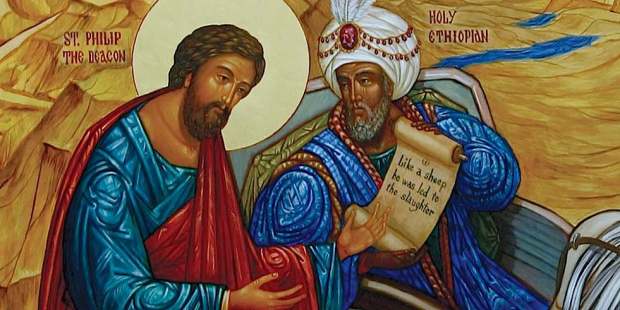
In looking to anchor this sermon in the Bible I was drawn to the only New Testament story that is unambiguously about a person of colour, the story of the Ethiopian eunuch and Philip (recognise how odd it feels just to read these names in the “wrong” order). I’ve been blessed by the background reading I’ve done and the new perspectives I’ve gained, particularly when I’ve read the insights of those who are different to me, different in their ethnic identity and different in their gender identity.

The story is far more important than I’d ever imagined. In the past I’d just filed it away mentally as one of many conversion stories in the Bible. But when people of colour or from sexual minorities read this story they see it, for what it is, a transformative moment in church history, the first time that the early Jesus movement reached out to someone different to themselves.

We can tell how important this story is from the meticulous attention to detail that Luke embeds in his writing. Indeed much of the insight I’ve been given in preparing for this service comes from looking at why Luke has included details that, at first sight, appear inconsequential.

One of the commentaries I was reading suggests we know more about the eunuch’s identity than any other character in the Bible. Let’s start off with the aspect that drew me to this story. He was black. Ethiopia as a country or region didn’t exist at the time. Ethiopian was then a generic term for an African negro. The term is composed of two Greek words meaning , burnt by the sun. He was a eunuch. His parents would probably have presented him for castration as a boy in order that he could become a servant in the household of an aristocratic female and thus guarantee him (and them) economic security for the future. It worked, he was now a high ranking official in charge of finances for the Queen of his country. He was a gentile, this isn’t stated explicitly but we know from Deuteronomy (23:1) that no-one who had been castrated could be or become a Jew. He was educated. He was reading the Scriptures, probably in a foreign language, at a time when few people were able to read at all. He was rich. We don’t know exactly what his “chariot” looked like but it was sumptuous enough to allow him to read and talk with someone else during the course of a journey. He felt rejected. He clearly sympathised with Judaism, he was reading the Jewish scriptures and returning from a pilgrimage to worship in Jerusalem, but he would not have been allowed to worship in the temple with the other men because he was a eunuch. He wanted to part of God’s Kingdom, but the majority Jews told him that his identity prevented that.

Why does Luke tell us all this? He tells us all this because it is the point of the story. The point of the story is that the eunuch is about as different from Philip, and the other followers of Jesus, as it is possible to get. Philip was Jewish, the eunuch was gentile. Philip was a Palestinian, the Eunuch was an African negro. Philip was male, the eunuch was, well, a eunuch. Philip was probably neither wealthy nor particularly well educated, the eunuch was both. Philip was part of the majority ethnic group, the eunuch was an outsider.

What on earth have these two got in common? How does Philip even start a conversation that results in the eunuch being converted to Christianity? You might think that he would start by telling the eunuch about his (Philip’s) experience of God. I think we often regard the role of the evangelist as being to tell other people about how he or she (the evangelist) sees God. Philip does exactly the opposite, he asks the eunuch what he is reading. His starting point is listening to the experience and viewpoint of the other.

There is then another instance where Luke appears to give us more information than we need to know. He quotes the exact passage that the eunuch has been reading (Isaiah 53:7-8):

32“He was led like a sheep to the slaughter, and as a lamb before its shearer is silent,  so he did not open his mouth.

33 In his humiliation he was deprived of justice. Who can speak of his descendants?  For his life was taken from the earth”.

Luke goes on and gives a further apparently unnecessary detail in remembering the exact question that the eunuch asked of Philip, “About whom, may I ask you, does the prophet say this, about himself or about someone else?” So take a moment to re-read the passage, who is it about?

Pause to allow reflection

If you are one of us, born and bred in the church, a well informed twentieth century Christian, then you will probably assume that the passage refers to Jesus. But what if you were a 1st century eunuch? Was he (the eunuch) like “a sheep led to slaughter” when his parents presented him for castration? Trusting in their best intentions for him did he “not open his mouth” in protest? Had the eunuch been deprived of justice when he was prevented from worshipping in the temple because of his earlier “humiliation“. “Who can speak of the descendants” … of a eunuch? He must have had times when it felt as if his life had been taken from him through that act (at least metaphorically).

I think the eunuch was studying this particular passage because he identified with the description that Isaiah was outlining. When he asked Philip who the passage was about, he was wondering if it applied to himself.

Philip could have reacted by telling the eunuch that he was wrong, that there is only one way of interpreting that passage and that there is only one way of relating to God. He didn’t, he “began with that very passage of scripture and told him the good news about Jesus“. The good news for the eunuch is that this passage relates the experience of both the eunuch and Jesus. Jesus knew what it was to be rejected and humiliated and so did the Eunuch. Through this shared experience the eunuch was able to enter into a relationship with Jesus in a way that was quite impossible for Philip who, like, us would probably have had much more limited experience of either humiliation or rejection. Philip is learning that there are more ways of relating to Jesus than those experienced within the early Jewish disciples.

But the significance of the passage doesn’t end there. If you continue reading for a couple of chapters, you come across this quotation (Isaiah 56:3-5):

…let no eunuch complain, “I am only a dry tree.” 4 For this is what the Lord says: “To the eunuchs who keep my Sabbaths, who choose what pleases me and hold fast to my covenant – to them I will give within my temple and its walls a memorial and a name better than sons and daughters; I will give them an everlasting name that will endure forever.”

Lo and behold what Philip and the eunuch discover, through exploring scripture together, is that the eunuch should not consider his condition as cutting him off from God, of excluding him from worship. This passage offers exactly the opposite, it is offering him a memorial within God’s temple and a name that will endure forever. The eunuch has felt excluded, beyond the reach of God, for as long as he can remember. When he and Philip explore the passage they find that it it is saying, “No, despite what the majority culture says, God has a special place for you in his heart”. No wonder he orders the chariot to be stopped. No wonder he asks Philip to baptise him.

Before I finish I want to make one further point that brings us back to where we started. We often assume that the primary point of this story is to record the conversion of the eunuch. There is, however, a very strong argument that it is also, and perhaps more importantly, about the conversion of Christianity. Before this story the early followers of Jesus had been in a bubble. They were all Jewish and probably only ever mixed with Jews. They all shared similar perspectives and life experiences and had a shared, Jewish, view of the world and of God. They regarded Jesus as the Jewish Messiah, the saviour of the Jewish people (just read Peter’s two early sermons [Acts 2:14 -40 and 3:11-26] if you’re in any doubt). Whilst the early Jewish Christians remained in this bubble then their essentially Jewish view of the world and of God remained unchallenged and unchanged.

It took one encounter with someone from outside to burst that bubble, for that view of the world and God to change forever. From that time on the disciples came to realise that Jesus was not the Jewish messiah, the saviour of the Jewish people, he was the Christian messiah, the saviour of us all. When Philip steps outside his comfort zone, when he starts to explore the words of scripture and the nature of God from the perspective of someone who is different to himself, a miracle happens. The world has never been the same since.

Like Philip I want to encourage us all to explore the nature of this world and of our God by listening to the stories, perspectives and histories of people who are different to us. This particular month let’s focus on the stories and histories of those from black or minority ethnic backgrounds. My personal pledge is to finish reading this book (“Why I’m no longer talking to white people about race“) … as soon as my wife let’s go of it.

Who knows? Miracles may happen. They are unlikely to be as profound and far reaching as that experienced by the early church, but perhaps like Philip, we will grow to understand and relate to God in a new and different way. Perhaps we will discover a bigger God than we could ever previously have imagined.

O Lord, send your Spirit to us today. Burst our bubbles.

This sermon has been heavily influenced by the writing and acting of Peterson Toscano.

Helping our community grieve for its planet

I’ve been struggling recently with how we respond to the degradation of our environment which seems to be continuing so uncontrollably. I feel a need to express my grief. The little video below is an attempt to do this which I shared in worship last Sunday (using a felt board and laminated cut-outs of the animals and plants).

We followed this by singing selected verses of “Think of a world without any flowers” which is becoming a more and more poignant song for me:

Think of a world without any flowers,
think of a world without any trees,
think of a sky without any sunshine,
think of the air without any breeze.
We thank you, Lord, for flowers and trees and sunshine,
we thank you, Lord, and praise your holy name.

Think of the world without any animals,
think of a field without any herd,
think of a stream without any fishes,
think of a dawn without any bird.
We thank you, Lord, for all your living creatures,
we thank you, Lord, and praise your holy name.

The nearest Biblical parallel to what we are facing seems to be that of the Jewish exile in Babylon and the experience that is articulated in Psalm 137, This  sermon attempts to draw out those parallels and offer our community a way through its grief.

In 597BC, after a revolt against Babylon, the new superpower in the Middle East at the time, a three month siege resulted in Jerusalem being pillaged, the Temple being destroyed and a large part of the population being captured and taken into exile in Babylon. They remained there as captives for approximately 70 years.

The effect was devastating on the people. They had lost everything they held dear. Many had lost family members in the wars or siege or had been separated from them when being forced into exile. They would have lost their possessions and homes and in many cases land that had been passed down through the generations. Perhaps most importantly, though, they had lost their God. Before the exile the Jews believed in a tribal God whose main purpose was to look after Israel. But Israel had been destroyed. That God had failed. Imagine what it must feel like to have a God who has failed. It would drive you to sit down by a river and weep. “My God, my God, why have you forsaken me?

How does that reflect our experience today? For almost as long as Christianity has been around it has felt that society has been progressing – moving in the right direction. The expansion and development of Christianity has occurred at a time of progress and development for humanity. It has been possible to see human progress as moving towards the coming of a Kingdom where slavery is no more, where women are no longer subject to men, where even poverty might be eradicated. Every successive generation has known a better world than its parents. It has been very easy to assume that a beneficent God has been looking after us and guiding that progress. In the words of Martin Luther King, “The arc of the moral universe is long, but it bends toward justice.

But now we see a world that is deteriorating, that might even be destroyed. The issues aren’t just about the environment. Throughout the world the gap between rich and poor is increasing, and the poor are really suffering. “Progress” has not brought happiness,  mental illness is rising rapidly. In many regions, including our own, there is political instability bordering on chaos and a feeling that our democratic institutions are failing. The current state of the environment is not only a depressing fact but also a metaphor for the state of our current society more generally.

It really feels to me as if the God who many like me believed to be guiding human progress has failed. There is a resonance between the grief of those Jews in exile in Babylon, who had lost everything including their confidence in God, and our present generation, who are in danger of losing everything and may already have lost their confidence in God. “My God, my God, why have you forsaken us?

The Jews were in exile for 70 years. The generation that went into exile and wept so bitterly died in exile. A whole generation grew up in exile and never knew any other way of living. It was only later generations that finally returned to what they had been told was their homeland.

When we look at the projections for how the climate will change over coming years then we face a similar but exaggerated situation. We, the generation present here, will almost certainly not live to see a return to anything that is seen as progress. Many generations will almost certainly live in a severely denuded environment, and probably with currently unimaginable political instability as rich and poor fight for what little food it is still possible to grow.

I do believe that eventually a generation will emerge who return to its homeland, who eventually recognise that the only way we can all live life to the full, on a finite and degraded planet, is to accept the gospel of love and community that is offered freely to all … but it will be a very long time coming.

Of course, some will see our predicament as God’s judgement and others will see the state of our earthly existence as essentially irrelevant when we look forward to spending eternity in God’s presence. Such ideas may comfort others, but they do little to comfort me. What I feel in my heart is an aching sadness for the world as it could be but isn’t. A sadness I can only describe as grief. “My God, my God, why have you forsaken me?

So I place myself alongside those exiles in Babylon and want to learn from them how to express, and live through, that grief. Elisabeth Kübler-Ross in her 1969 book On Death and Dying identified 5 stages of grief and we see many of them in that Jewish experience, and in our experience today.

First is denial and isolation. The Jews could not deny that they had been physically removed but they did continue to live in isolation from their captors and continue the religious practices that, one could argue, had led them to be in that position. Today we  definitely see denial of what is happening to the world and a desire to carry on as usual.

Then there is anger. We don’t often hear the second half of psalm 137 read out but how can wishing your enemies’ children’s heads be crushed against rocks be anything other than an expression of anger. I feel anger today for how the planet is changing. I suppress it, but that only means it emerges as tears rather than violence. Greta Thunberg feels that anger and expresses it far more powerfully than I can.

Bargaining comes next. How many of the psalms (many of which scholars now believe where written or at least edited during the exile) embed some element of an attempt to bargain with God. As we read in Psalm 137:

If I ever forget your holy city, LORD,
may my arms be turned into twigs and burned.

How often do we attempt to bargain in our response to environmental change, “Surely if I choose to cycle more often and install solar panels I will have done enough” or “we as a nation should only act if other nations are willing to act alongside us”. The bargaining is doomed to failure because it fails to acknowledge the reality of the situation.

Then depression, sitting down and weeping by the river, descending into mental ill-health as individuals and as a society.

But finally comes acceptance.  Eventually the exiles did come to accept that the exile was real and learnt that they had to accommodate to their loss. Many of the stories of the exile are of Jews flourishing as individuals or as a group within their new circumstances. Acceptance doesn’t restore what is lost, but it does allow us to begin to live fulfilled lives again despite that loss. In terms of how our planet is changing we will eventually accept that the planet has lost much of the beauty we appreciate today, but when we do we will find different ways of living fully as God intended.

That is why it is so important for us to work through our grief because it is only when we have accepted it that we will look for these new ways of living. I included our gospel reading earlier (Mark 15:25-37) that it is only when we have accepted the grief of what Jesus went through on the cross that we are able to embrace the new way of life that we experience as Resurrection.

At this time helping our community to grieve may be one of the most important roles the church has. The support we offer at funerals and otherwise during grieving is one of the last points of contact that we still have with many people in our community. We know how to support people through grief when they lose a loved one. Maybe we should develop our expertise in allowing people through their grief for this planet. Maybe acts of lament like the story I told earlier on might be one way of allowing people to express and live through their grief.

It is also important to work through stages of grief because grief is disabling and disempowering. We become paralysed and unable to help ourselves. What could better describe our human society at the moment than paralysis and inability to help ourselves? Moving through the stages of grief to acceptance frees us to act and to transform.

Accepting the awful reality of what is happening to our planet can break us out of that paralysis and empower us to act as agents for change. Jeremiah was a prophet at the time of the exile. He is famous for his lamentations, for his grief for his nation. It was through embracing and working through that grief, however,  that he became one Israel’s greatest prophets and one of the most powerful advocates of societal change and a demand for social justice that the planet has ever seen.

That is what our society today needs. It needs prophets to advocate new ways of living on a finite planet with finite resources. It needs the imagination to dream up a new economic system that are not dependent on continual growth and the inevitable increases in consumption of resources that this entails. It needs demands for justice in the sharing of our human and natural resources. Above all it requires prophetic voices to remind us that what is required is for us to love the Lord our god with all our heart, soul, mind and strength and to love our neighbours as we love ourselves.

We cannot do this if we are paralysed by grief, but if we work through that grief to accept our loss then we can be liberated to work for the coming of the Kingdom. The world will almost certainly be transformed by climate change, but, if we liberate ourselves to action, there is still a chance that the physical and biological changes can be limited. Perhaps more importantly, that change will only be brought about if we can direct our society away from competitive individualism to the social cooperation and justice which is the heart of our gospel. We must work through our grief and be liberated to go once more into the world to love and serve our Lord.

My thinking has been influenced heavily by three different sources:

  • reading Walter Brueggemanm’s classic, “The Prophetic Imagination” at our theology book club,
  • being led in a staff retreat in February on “How can we sing the Lord’s song in a foreign land?” by Jasmine Devadson earlier in the year,
  • attending workshops with Extinction Rebellion at this year’s Greenbelt Festival.


The Church and Political Protest

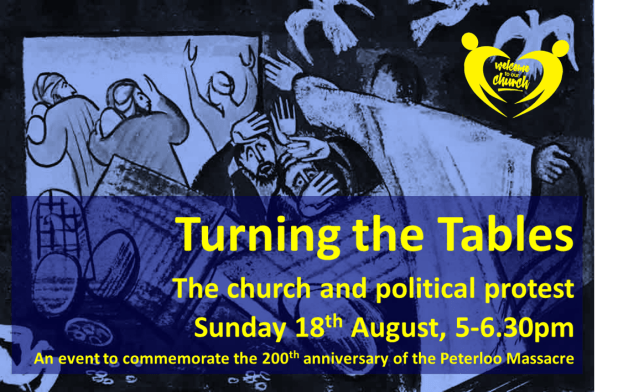
On 18th August our church held a “pop-up” event to commemorate the 200th anniversary of the Peterloo massacre. It was inspired by an earlier celebration at Manchester Cathedral which had pointed out that committed Christians had been involved on both sides of the political divide at Peterloo. Many non-conformist Christians had been helped organsie the protest but there were prominent clergymen amongst the group of magistrates who ordered the troops to disperse the crowd. We thus had a session to explore whether and how individual Christians and the church as an institution should engage in political protest today. This started hearing from two Quakers who are involved in protests against the arms trade, a representative of Extinction Rebellion and a Methodist minister involved in opposing expressions of hate against minorities. After this we had a time of open discussion of the issues followed by an act of worship.

During the worship we read Luke 19:37-48, the story of Jesus entry into Jerusalem and Palm Sunday and leading to him turning the table of the money-lenders in the courtyard of  the temple which led into this sermon.

Should Christians engage in political protest?

We’re so used to thinking of Jesus as a preacher and religious teacher that we often ignore his role as a prophet and political agitator. We sometimes consider him other-worldly, but much of his teaching reveals a very shrewd understanding of human nature and how the world works. He knew that the common people that he had grown up with were oppressed. The most obvious oppression was that coming from the Roman occupying forces, but Jesus also knew that within the local population the poor were oppressed by the rich. He was particularly saddened to see the many pharisees supporting this oppression either implicitly or explicitly. Much of his teaching, particularly through his parables, and many of his actions, make as much sense as political theory as they do as theology.

Let’s look at the story of Palm Sunday. We’ve heard this told so often in church services accompanied by children’s processions, the waving of palm branches and the singing of upbeat worship songs that we assume that this was originally a religious event. Jesus leads a procession into the city of Jerusalem from the east. It certainly had religious overtones, but it was also highly political. The only other person who would process through the city gates into Jerusalem was the Roman Governor accompanied by his troops.

It’s quite likely that the Governor, Pontius Pilate, was processing into the city from the west on that very day. Jerusalem always filled up with people at Passover. The crowds were generally peaceful but, just as the Magistrates at Peterloo considered it expedient to have over a thousand troops available just in case, so Pilate wanted troops who could disperse the crowd if necessary. In the lead up to the festival each year he would lead them into the city to remind the people who was in control. By staging an alternative procession into Jerusalem, Jesus was promoting himself as an alternative to Roman authority. His procession was no accident, Jesus had made elaborate plans (Luke 19:30) to ensure that a colt is available and that the demonstration would have maximum effective.

“Blessed is the King who comes in the name of the Lord” (Luke 19:38) sounds like a religious chant but it is first and foremost a political claim. If this is the King, then what authority does the Roman Governor or even Caesar himself have?

It’s for this reason perhaps that the pharisees rebuke Jesus (Luke 19:39). There was an uneasy coalition between the Jewish leaders and the Roman authorities. If the Jewish leaders ensured that the people were peaceful and paid their taxes, then the Romans allowed them to continue in positions of power and influence. The Pharisees are trying to hush Jesus and his followers up. “Keep quiet”, they are saying, “don’t you realise what trouble you could get into, and get us into”.

Jesus reply? ”I tell you if we keep quiet the very stones will shout out” (Luke 19:40). The signs of oppression and injustice are so clear that it doesn’t really matter whether we draw attention to them or not. This recognition drives him to tears (Luke 19:41). He weeps for a society that cannot even see the way to peace through justice and is destined for destruction as predicted by prophets like Amos (e.g. Amos 8:1-8).

Following his entry into the city he proceeds further to the Temple. He’s been there before. He knows what to expect. Although the Jewish authorities know that the Temple should be a house of prayer, he knows that they tolerate the money lenders as long as they are given a share of the profits. His actions are not an impulsive outrage at a surprising finding, they are pre-planned to create maximum effect in a response to a situation he knows he is going to encounter.

Although the procession appears to be in defiance of the Roman authorities and the turned tables were those of the money lenders, both protests are effectively against the Jewish authorities and their complicity with power (the Romans) and money (the money lenders). The Romans and money lenders didn’t, or couldn’t, know better but the Jewish authorities, so well versed in the Torah and words of the prophets, were guilty of ignoring both.

Jesus realised that imposing a solution with force could never work. The Romans imposed peace, and did it very effectively, but that imposed peace had a huge human and financial cost and could only last for as long as the force was there to impose it. Jesus advocated God’s peace, a peace that would last forever. That is only possible if it arises out of the people’s desire for justice.

Jesus’ chose particular actions not because they were likely to be effective in themselves. He knew that a small group of unarmed Galileans led by a man sitting on a donkey was no match for the might of Rome. He knew that upturned tables could be replaced almost immediately. Instead he wanted the people who saw what he was doing to start questioning what they regarded as inevitable and unchangeable. He wanted them to be incensed by the injustice of what was being imposed on them by the forces of power and wealth. He wanted them to first glimpse, then desire and then work for the peace that comes through justice rather than the sword.

So if you ask me, “Should Christians become involved in political protest”, I will answer with an unequivocal “yes”. Jesus planned and executed political protests himself, he showed us how to do it, he wrote the rule book. If we are called to follow Jesus then we should be following both his political agitation as well as his religious teachings. The question for me is not so much “if?” but “how?” and “when?”. It’s this that we’ve been tussling with earlier in the afternoon and that I hope we’ll pray about in the rest of the service.

The riddle of prayer

A sermon looking at three different gospel accounts of Jesus teaching on prayer; Matthew 6:5-9Luke 11: 5-13, John 14:9-14.

Today is one of those days when a number of things have pointed me towards what I have to say. As I’ve explained earlier several coming events in our churches life (Peterloo pop-up, Day of prayer for Britain and our Science and the Language of Prayer seminar series) relate to prayer. We had our 4th Sunday two weeks ago when we don’t feel compelled to use the lectionary but if we have found Luke’s memory of Jesus’ teaching about the Lord’s prayer. Seeing as we missed out on it then I thought we might pick up that theme today and spend some time thinking about prayer in general and the Lord’s Prayer in particular.

Although prayer is central to a fully Christian life, many Christians find prayer difficult. I remember a couple of months ago Philip ran a series of sessions on prayer after church. In advertising these he emphasised that they were intended for people who found prayer difficult. Having marketed the sessions this way we found them to be better attended than any study group either of us can remember.

I don’t think the difficulty comes form one single issue, there are multiple reasons. Some people lack confidence that they are praying properly (whatever that is). Others may wonder how sensible it is to ask God to intervene in a world that we know functions according to well established scientific laws? Others may have felt that their prayers have gone unanswered in the past? Others may find that they get little out of prayer and it becomes a chore?

So what do we make of Jesus teaching on prayer? Well there is a riddle here, particularly in relation to the Lord’s Prayer. The riddle is that when we read Matthew and Luke’s different accounts of what Jesus taught when he introduced people to the Lord’s prayer we appear to get very different advice on how to pray.

Matthew places Jesus’ teaching of Lord’s prayer within the Sermon on the Mount and leads into it with the sentence:

When you are praying, do not heap up empty phrases as the Gentiles do; for they think that they will be heard because of their many words.  Do not be like them, for your Father knows what you need before you ask him.

Matthew 6:7-8

There is Certain sense in this. If we believe that God knows everything then what is the point of spending a long time explaining a situation to Him? Indeed what is the point of telling him about the situation at all? In the light of this autumn’s prayer events – what is the point of a group of Christian’s travelling to London to tell God about the problems that face Britain? Surely God already knows that Britain is going through a trying time?

Luke remember Jesus introducing the Lord’s Prayer at a private conversation amongst the disciples after they had watched him praying himself. Jesus continues afterwards with the parable that I retold to the children earlier and the message could hardly be more different to Matthew’s:

I tell you, even though he will not get up and give him anything because he is his friend, at least because of his persistence he will get up and give him whatever he needs.

Luke 11:8

He then goes onto the famous passage on which our hymn was based about “ask and it shall be given unto you”. This teaching is mirrored in the parable of the unjust judge (Luke 18:1-8) which Luke relates a little later in his gospel. A widow comes and pesters a judge repeatedly until he finally gives in and grants her the judgement she is after.

But if you think about it, Matthew and Luke appear to be saying quite different things.  Matthew seems to be saying keep you prayers simple and short, because God already knows what you want, and Luke seems to be saying the opposite, keep on reminding God of your prayers and he will award your persistence. How do we make sense of this riddle?

I think the starting point is to look at the Lord’s prayer itself. So often when we talk about prayer, and particularly whether it works or not, we focus on those prayers when we ask God to do something for us. We pray for God to reconcile our country or to heal someone we know who is ill or to rectify a situation is some remote part of the world. These are our prayers of petition and intercession, petition if we are praying for something for ourselves and intercession if we are praying for other people.

Yet these types of prayer are entirely absent from the Lord’s prayer. The closest the Jesus comes in the Lord’s prayer to prayers of petition or intercession is “Give us this day our daily bread”, which is fairly basic request for minimal sustenance. Nowhere else is there any suggestion that we should be praying that God will do what we want him to do. There is absolutely no suggestion that when we pray to God we should offer him a long list of people or situations in the expectation that he should intervene and sort them out.

What we do have is a clear injunction to listen to what God wants

“The kingdom come, thy will be done, on earth as it is in heaven”.

Matthew 6:10

Prayer as presented in the Lord’s Prayer is not fundamentally about us telling God what we want – it is about us listening to what God wants. Perhaps we can personalise this a little further – it is about listening to what God wants us to do. Once we have understood his purpose then we also stand a possibility of understanding the part he wants us to play in bringing that purpose about.

With this understanding of prayer, the teaching of Matthew and Luke can make sense together. Matthew says do not use long prayers because God already knows what you want. Of course God knows what you want, what is important however is you finding out what God wants. You shouldn’t use lots of words because the main point of prayer is not you telling God what he should do, but you listening to God telling you what you should do.

Viewing prayer like this also alters how we view Luke’s call for persistence. If the aim of prayer is to understand what God wants rather than persuading him to do what we want then the result of persistence is not to persuade him to change his mind, but for us to eventually understand what it is that he wants. Think about that phrase, “seek and ye shall find”. Thinking about making a real effort to find something. If we persist in our search we don’t expect to change the thing we are looking for. If we are looking for an apple we don’t, by searching persistently, expect to find an orange. What we expect to do is to increase the probability of finding the apple. What will be given to us, if we ask persistently enough is a vision of what God requires of us. If we gather in London, physically or virtually, to pray for this country, our prayer is not to persuade God to implement our vision of what will bring healing to our nation, it is to discern God’s vision of what will bring that about and act accordingly.

In case we have any doubts about prayer as a time for us to discover God’s will and the persistence that is required to do this, we need to move forwards in time to Jesus prayer in Gethsemane. Jesus knew by this time that adhering to God’s vision of the future was to live continue to live a life of truth and love which would inevitably lead to his execution by crucifixion. Despite this his prayer was not to be rescued but to have the strength to persist.

“Yet not my will but thy will be done”.

Mark 14:36, Luke 22:42, Matthew 26:39&42

I want to add on a note about Jesus teaching on prayer as recorded in John’s gospel and specifically on the understanding that:

“If in my name you ask me for anything, I will do it.”

John 14:14

If we are lazy then we take this just as a form of magic words, we assume that if we end our prayer by saying “we ask this in the name of Jesus” then we are in some way guaranteeing that our prayer will be granted. If we’re honest, most of us will recognise that this doesn’t work. How often have each of us asked for something in prayer in Jesus name only to find that nothing changes.

Praying in Jesus name is not just a form of words we add onto a prayer to guarantee its success. Praying in Jesus name is a test of our prayer. Are we really praying for what Jesus wants or for what we want? It goes back to the Lord’s prayer, are we praying to do God’s will or for God to do our will? It is only if we are praying to align ourselves with God’s will, to pray in Jesus name that our prayers have any chance of success.

So what does this mean practically?

Prayer is a conversation and a two-way conversation. It’s not just about telling God what we want – it’s about listening to god telling us what he wants.

We need space to listen. If we are having a conversation with someone who is our equal then we should expect to spend at least as much time listening as speaking. If we are having a conversation with someone who is wiser or more knowledgeable than us, then it is only sensible to spend more time listening than talking. With God we should spend far more time listening than talking.

In listening we need to become aware of how God speaks to us. I’ve spoken to many people who experience prayer just like a conversation with a friend when they hear an almost audible voice. My experience of prayer is more like listening to a voice deep down within myself, a nagging of my own conscience. Listen for how God is speaking to you, and acknowledge his voice however you hear it.

But we also need persistence in that listening. It might be that the first time we listen we cannot hear God responding, or that we do hear but it doesn’t make sense, or that it does make sense but we are not comfortable in what it seems to be requiring of us. The chances are that the more difficult the situation we are praying about the more persistent we will have to be to discern God’ will. God will answer, if we invest enough time in listening.

Finally, if prayer is ultimately about listening to how we can do God’s will, then we should spend more time praying about those issues that we can do something about effectively than those that are remote form us. We should never forget people who are struggling and desperate on the other side of the world, or even this nation, but our prayers to bring about God’s Kingdom are far more likely to be effective if they are about situations in which we have some personal involvement and agency. If you only have a limited time for prayer, and everyone does, then it only makes sense to focus those prayers on people and situations that are close to you.

So let’s pray Biblically:

  • Let’s limit the words we use in order that we can listen to God.
  • Let’s pray persistently to ensure that we hear God’s will and act upon it.
  • Let’s test those prayers to ensure that they are offered and recieved in Jesus’ name and not our own.
  • Let’s focus our prayers on situations where we are likely to be most effective in working in order that God’s Kingdom comes, that His will is done, on earth as it is in Heaven

Singing praises while feeling low

A sermon based on the lectionary for this week: Psalm 30 and Galatians 6:7-16 exploring how we can continue to praise God despite poor mental health. (The links take you to Nathan Nettleton’s paraphrase of the readings which spoke to me particularly this week)

Preparing my sermon has been particularly difficult this week. We’ll be holding a meeting after church about future and whether we might be able to adapt what we do on a Sunday morning to help us to grow in the depth of our discipleship and in numbers. Trevor’s chairing and I asked him if there was any particular theme it might be useful to address to support that meeting. Not particularly he said,  but “we might have a focus on God’s love and goodness towards us and a real opportunity to worship”.

This seems quite innocuous, except that it’s not particularly in tune with how I’ve been feeling recently. For perhaps five years or so I’ve struggled on and off with my mental health. Quite a lot of the time I feel fine but every so often I go through patches when I just feel low and drained. I find it difficult to concentrate and start to feel very tired quite early in the day. Given this there are often days when I don’t achieve very much and this can make me feel worse. Feeling tired I can be tetchy and irritable and my family suffer.

Over the period when I’ve experienced these feelings I’ve got to understand them more but I still don’t know what triggers them. There’s an element of feeling helpless and devastated when I look at the challenges that face us in all in the 21st century, climate change, Brexit perhaps. It didn’t help to go into Manchester on Wednesday evening and be confronted with all those people living rough on the streets. It doesn’t help[ that my mother is in hospital with much, much deeper depression than I have. But there is something internal as well, something darker, which I can’t explain.

I do know that given time, a couple of weeks perhaps, I’m likely to start feeling better, again without really knowing what drives this. Then I’ll be relatively fine for a period. It doesn’t feel serious, just like having a minor physical ailment that recurs every so often and knocks the sparkle out of life. It does mean, however, that leading a service of worship focusing on God’s love and goodness and offering the congregation a real opportunity to praise is a challenge.

I’m not alone of course. The statistics estimate that at any one time as many as 1 in 6 of us has some sort of “common mental disorder” (that’s the official term). I’m sure many of you will recognise the symptoms I describe. Some will be feeling like me now, others will have been through periods like this in the past. Many may have family members who are affected. An increasing number, like me, will be finding that this is the way life is, and learning to live with it.

Although the statistics suggest an increase in mental health problems within our society it is something that has always been there but has been hidden or has manifested itself in different ways in the past. Today’s psalm was written by someone who clearly knew ups and downs in their life. There is nothing in the psalm to suggest whether this was physical or mental (or indeed whether it had anything to do with health at all), but the words speak to me. I see in them a reflection of my own situation. I also hear, in them, a note of hope. The psalmist is someone who has experienced darkness in the past but has felt rescued by God and he gives thanks correspondingly:

You turned my tears to laughter;
you set my dragging feet dancing;
you dusted me off and dressed me up for a party.
So now I’m singing your praises
from the bottom of my heart,
and no one can shut me up!

I may not feel good about myself now, but I have hope that with God’s help, it won’t be long before I start to feel better and am more in the mood for celebration.

One of the risks of responding to the psalm in this way, and of a certain more general strand in Christian thinking, however, is that we respond to our situation passively. We can get trapped into thinking that all we have to do is to offer our situation to God and wait for him (or her) to act. This is almost exactly the opposite of what modern psychology prescribes. The worst thing that most people with mental health problems can do is give in to the feelings of hopelessness and despair and wait for something to happen. Rather than abandoning ourselves to God we need to open our lives to him and work with him. What is required is not passive surrender but active engagement.

The passage we heard read from Galatians earlier is, at one level, a collection of throw away lines that Paul assembles to encourage the readers after he’s given them a particularly harsh talking to about a completely different issue. But just as in the words of the psalmist I recognise a description of how I am, so in Paul’s words I see a description of what I can do about it.

What you put into life determines what you’ll get back.

This is not a gospel of passive acceptance of where we are, of allowing God to do all the work. It is an invitation to start thinking about how we can make a contribution to life.

If your investments are all in your selfish impulses, they’ll pay out a dividend of degradation and misery.

If when we are low we give into the demons and allow ourselves to sink to where they are dragging us then we will only get worse.

But if you invest in the way of the Spirit your investment will yield rich dividends.

If despite how low we feel we can invite God back into our lives then we are on the road to recovery. The paraphrase uses the concepts of investment and rewards whereas a literal translation would speak of sowing and reaping. Whichever, the important message is that if we do small things now then we set ourselves onto the path to a better place sometime in the future.

If we don’t lose patience, but stay in for the long term, we will be richly rewarded.

If we expect dividends immediately, we will be disappointed. People with mental health conditions very rarely just snap out of it, but if they start taking small steps, moving in the right direction, they can get better. Once we start to walk with God, God will start to walk with us. It is, as Paul says, a matter of patience, and we can trust that if we stay in it for the long term we will be richly rewarded.

The final relevant point that Paul makes in this section is that the key to improvement is to move away from introspection.

Let’s take every opportunity, then, to contribute our energies to making the world a better place for everybody.

The fundamental task of Christians as individuals and the church is to work for the coming of the Kingdom. In the passage that was set from this letter for last week Paul makes the commandment to love our neighbour the single most important test of everything we do. It is through giving for others that we find ourselves. Probably the most restorative action that anyone feeling low can take for themselves, is to do something caring for someone else.

And as a starting point, let’s especially care for our co-workers in the community of faith.

The easiest place to start is with those who are closest to us, our families, our neighbours our colleagues and our co-workers in this community of faith. Let this community be a place in which we can all support each other. Importantly let’s value what each and everyone has to offer. It’s very tempting to be most accepting of what is offered by those who are dynamic and thrusting and forceful, but let’s also be receptive to accept from those who are timid and lack confidence. Let’s welcome the meek, because they will inherit the earth.

There is hope even for those who feel at their lowest. There is hope for me, who’s only feeling a little bit down. The psalmist talks of passing from that place of despair and death to one of hope and healing. This is not some fiction, it is lived experience of how God can restore once we have invited him into our lives. It is an experience that was real to the psalmist 3,000 years ago and can be just as real in our lives. If we don’t experience it today then we can still hope for it in the future. I can give thanks and praise in anticipation.

Paul maps out the pathway to that healing. We need to open ourselves to God and to work with him. Our expectation should not be of immediate, miraculous, recovery requiring nothing form us. Instead we are offered an opportunity to start to walk with God and each other. The progress we make with each small step may be imperceptible, but over time and with patience, those steps will mount up and bring us closer to coming Kingdom. Our lives will be restored and one day we will sing God’s praises once more. Let me give thanks and praise now for that promise of a brighter future.